
By Mark Smith 02/08/2026
Under: PPE and WorkwearUK PPE & Safety Regulations: The Complete Guide for Construction
Adhering to the UK’s PPE and safety regulations is crucial for every construction company. Our comprehensive guide covers all the essentials regarding legal obligations, the responsibilities of workers, and key practices for maintaining site safety.
From getting familiar with the latest standards set by the Health and Safety Executive (HSE) to picking out the appropriate personal protective equipment, this resource is designed to help keep your construction site not only safe but also compliant and efficient.
No matter if you’re an employer, site manager, or tradesperson, this indispensable guide serves as your trusted reference for understanding the laws surrounding construction safety in the UK.
Why PPE Matters on Every Construction Site
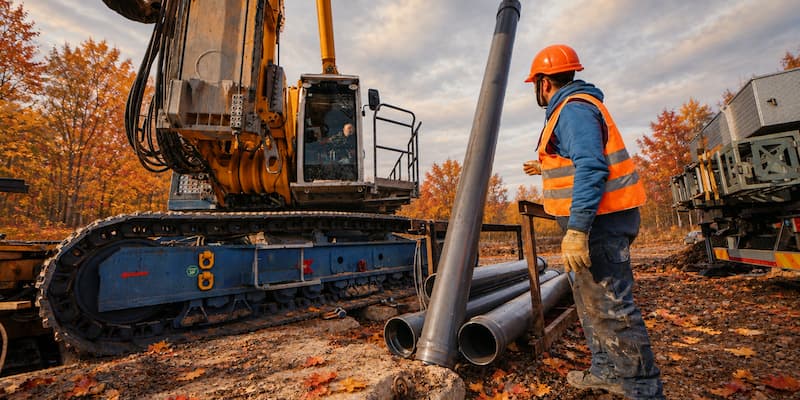
Construction is still one of the most risky industries in the UK, and the employees face various threats, including falling objects, moving vehicles, hazardous dusts, high levels of noise, work at heights, and manual handling daily. Though some of the threats might be minimised with safer practices, engineering solutions, and better site planning, personal protective equipment becomes the last resort in case it is impossible to get rid of the risks.
According to the health and safety law in the UK, an employer must carry out a risk assessment, provide appropriate PPE for its workers, explain how to handle, use, clean, and store equipment, and do it all free of charge. Not only will the right choice of PPE minimise possible injuries, but it will also prove that you comply with the HSE requirements.
Whether you're managing a large commercial project or working as part of a small building contractor, this information will help you keep your people safe from injuries and fines.
Quick Summary of UK Regulations
Who needs to comply
Every construction employer in the UK, along with contractors and self-employed workers, falls under the Personal Protective Equipment at Work Regulations from 1992, which were updated in 2022, and the Health and Safety at Work Act of 1974.
What’s required
Employers are required to assess risks, provide appropriate PPE at no cost, ensure it’s used correctly, provide training, and keep accurate records of compliance.
When it applies
It’s always relevant, but remember, PPE should be your last line of defence after other safety measures, like engineering and administrative controls, have been put in place according to the Hierarchy of Control.
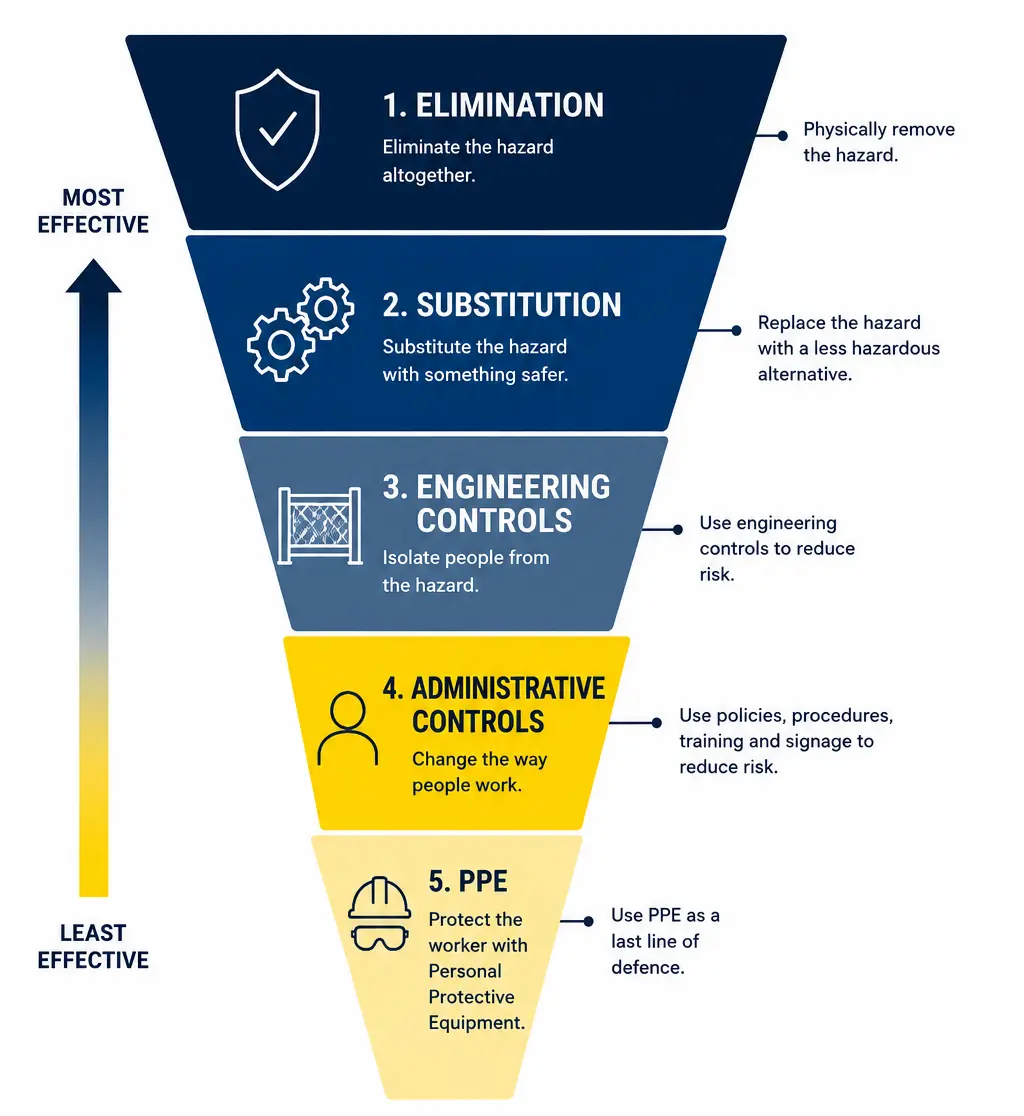
Understanding the Hierarchy of Control
While many believe that the use of PPE forms the first point of defence in protecting workers, UK health and safety legislation makes it abundantly clear that it should always be the last resort.
When choosing to use PPE, the employer should evaluate whether the risk could have been avoided completely; reduced using alternatives to materials or machinery controlled by means of engineering methods like dust extraction, edge protection, or machine guarding controlled by administrative controls like training and supervision and, finally, whether PPE is required to control any residual risks.
The Hierarchy of Controls process helps construction businesses meet compliance standards of both the Personal Protective Equipment at Work Regulations and the Management of Health and Safety at Work Regulations.
Quick reference checklist
- Risk assessment completed
- PPE provided (fit-for-purpose and compliant with current UK product conformity requirements, including recognised CE and UKCA marking where applicable)
- Fit testing (respiratory protection)
- Records & signage maintained
- Regular inspection & replacement schedule in place
Free Downloads
Employer Obligations under UK PPE Regulations
According to the Personal Protective Equipment at Work Regulations 1992 (amended in 2022) and the Management of Health and Safety at Work Regulations 1999, it's crucial for employers to take specific actions.
- First and foremost, they need to evaluate the hazards present in the workplace. This involves pinpointing risks that can't be managed through other methods.
- Ensure that appropriate personal protective equipment (PPE) is provided at no cost. This PPE should bear CE or UKCA markings. It must also meet the necessary BS EN standards, such as EN ISO 20345 for safety footwear.
- Make certain that PPE is used correctly and maintained properly. Employees should receive adequate training and supervision. All equipment needs to be cleaned, stored appropriately, and replaced if it becomes defective.
- Keep thorough documentation of all PPE issued, along with maintenance records and training sessions.
- Collaborate with contractors and subcontractors, as each employer holds responsibility for their own workforce.
Since the 2022 amendment to the Personal Protective Equipment at Work Regulations, there is an added responsibility for employers in the provision of suitable personal protective equipment at no cost for those workers who are not classified as traditional employees, which includes agency workers and limb (b) workers within scope of the regulations.
Who is Responsible for PPE on a Construction Site?
Many construction projects have principal contractors, subcontractors, agency workers, and self-employed trades. Understanding who is responsible for supplying PPE helps avoid confusion and ensures legal compliance.
PPE Responsibility:
- The employer will provide suitable PPE to their own employees and qualified workers.
- Subcontractors will always be responsible for providing protection to their own workforce unless there are any other contractual agreements.
- Principal contractors will have to coordinate the health and safety in the construction project according to CDM 2015.
- Self-employed workers will have to use PPE where there are still some risks after other control methods.
- PPE has to be given to the visitors wherever it is required according to the site guidelines.
Construction PPE Checklist
Before starting work each day, construction workers should check:
- Hard hat free from cracks or damage
- Hi-vis clothing clean and clearly visible
- Safety boots in good condition with adequate grip
- Gloves suitable for the task
- Eye protection clean and undamaged
- Hearing protection available where required
- Respiratory protection correctly fitted
- Harnesses inspected before working at height
Daily inspections take only a few minutes but can significantly reduce the likelihood of equipment failure.
Selecting the Right PPE for Construction
PPE plays a crucial role in keeping everyone safe and adhering to regulations on construction sites. From helmets to hi-vis safety vests, having the proper PPE can significantly reduce risks and help avoid serious injuries.
Here’s a list of must-have PPE for construction workers, aimed at ensuring that each individual stays safe, effective, and in line with industry safety guidelines.

Head Protection
Hard hats should be replaced whenever they suffer a blow of any importance, regardless of whether there is any obvious damage to the hat. UV rays, chemical exposure, and high temperatures could affect the life of the safety helmet, so manufacturers’ recommendations should be adhered to.
- Regulation: PPE at Work Regulations, BS EN 397
- Examples include: Hard Hats and Safety Helmets. These items must withstand impacts and prevent penetration; always check their expiry dates. It’s not one size fits all. Learn more about head protection.
Eye and Face Protection
- Standard: EN 166:2002
- Remember always to wear: Safety Glasses and Goggles. Learn more about eye protection.
Hearing Protection
- Regulation: Control of Noise at Work Regulations 2005 and BS EN 352.
- Product suggestion: Ear Defenders. Browse hearing protection.
Respiratory Protective Equipment (RPE)
The construction workforce is frequently subjected to RCS due to the operations of cutting, grinding, and drilling of the masonry products. The consequences of prolonged exposure are serious illnesses such as silicosis and lung cancer. In cases when the dust is not controlled by watering or LEV, it is necessary to select appropriate RPE based on the COSHH evaluation.
- Standards: EN 149 for disposable masks, EN 140/EN 14387 for reusable options.
- Recommended products: Respirators and Masks. Selection should be based on a COSHH risk assessment. Browse respiratory protection.
Hand Protection
Different types of gloves are used for various activities. Cut-resistant gloves that can be used to handle steel might not necessarily be resistant to chemicals, whereas chemical-resistant gloves might not offer any resistance to cuts or impacts. Gloves need to be selected according to the type of hazard in the workplace.
- Standards: EN ISO 374 for chemical, EN 388 for mechanical
- Suggested product: Work Gloves. Learn more about hand protection.
Foot Protection
Safety shoes can be found in various protection classes, which include S1, S1P, S3 and S7 categories under the EN ISO 20345 standard. Selection of the proper footwear will depend on site conditions, such as water, risks of piercing, unlevel terrain and heavy loads.
- Standard: EN ISO 20345:2021
- Recommended product: Safety Boots. Learn more about foot protection.

Body and Visibility Protection
High-visibility clothing should remain clean and in good condition. Dirt, fading and excessive wear can reduce its reflective performance, particularly during night work or poor weather conditions.
- Standard: EN ISO 20471:2013
- Suggested product: Hi-Vis Clothing. Learn more about hi-vis.
Fit Testing for Respiratory Protection Equipment (RPE)
Fit testing is mandatory when using tight-fitting RPE (e.g. FFP3 masks, half masks).
- Types of tests: These can be either qualitative, which involves tasting or smelling, or quantitative, focusing on counting particles.
- Frequency: You should conduct these tests before the first use and repeat them if there are any changes in face shape, like due to weight loss or dental procedures.
- Recordkeeping: It's important to keep all documentation for a minimum of five years.
PPE Inspection, Maintenance and Replacement
PPE needs to be regularly checked to ensure that it is still fit for purpose.
Proper checks include:
- Checking daily before usage by wearer
- Inspections of specialized PPE
- PPE cleaning in accordance with the manufacturer’s guidelines
- Immediate replacements of any worn-out/expire PPE
Using an electronic PPE register will help keep track of all this information easily.
Recordkeeping & Documentation
It's essential for employers to keep accurate records and documentation related to safety equipment. This includes:
- Records of training and induction sessions
- Certificates confirming fit tests
- Logs for maintenance and inspections
Helpful Tip: Consider setting up a digital PPE register. This can help you monitor expiration dates, schedule inspections, and track replacements more efficiently.
Free Download: PPE Register Template
Signage & On-Site Requirements
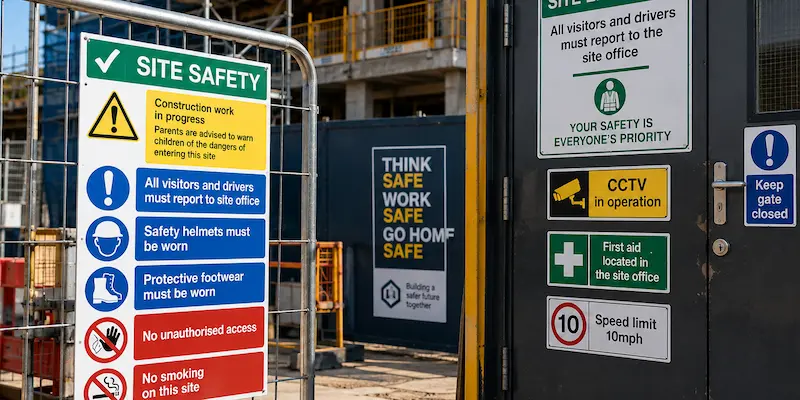
The Health and Safety (Safety Signs and Signals) Regulations 1996 state that where personal protective equipment (PPE) is needed, there must be clear and noticeable signs. These signs should follow the BS EN ISO 7010 standards, which cover the recognised safety symbols.
|
Sign |
Meaning |
Example Location |
|
Blue sign with white symbol of man wearing a hard hat. |
Head protection must be worn |
Site entrance |
|
Blue sign with white symbol of hi-vis vest |
High-visibility clothing required |
Loading areas |
|
Blue sign with white symbol of man wearing a RP |
Respiratory protection required |
Dust zones |
PPE & COSHH
According to the COSHH Regulations (Control of Substances Hazardous to Health 2002), Personal Protective Equipment (PPE) should be considered as the last line of defence.
Employers are required to:
- Carry out a COSHH assessment for any hazardous materials, such as cement, silica, solvents, and more.
- Choose PPE that specifically guards against identified chemical or biological risks.
- Ensure that respiratory protective equipment (RPE) and gloves meet the necessary EN standards.
Recommended Products by Regulation
|
Regulation / Standard |
Required PPE |
Example Product Category |
Website Link |
|
PPE at Work Regs 1992 |
General PPE |
All PPE |
|
|
EN ISO 20471 |
Hi-vis clothing |
Jackets, vests |
|
|
EN ISO 20345 |
Foot protection |
Safety boots |
|
|
EN 388 / EN 374 |
Hand protection |
Gloves |
|
|
EN 149 / EN 14387 |
Respiratory protection |
RPE |
|
|
EN 397 |
Head protection |
Hard hats |
Free Downloads
FAQ — PPE Regulations for Construction (2025)
Q1. Are CE-marked PPE products still legal in Great Britain?
Yes. Government policy continues to recognise CE marking for many products placed on the Great Britain market, including much PPE. Businesses should ensure any PPE they purchase complies with the latest UK product conformity requirements and is sourced from reputable suppliers.
Q2. Who pays for PPE in construction?
It's the responsibility of employers to provide PPE at no cost, which also extends to agency and casual workers.
Q3. How often should PPE be inspected or replaced?
It's essential to adhere to the manufacturer's guidelines; generally, visual inspections should happen monthly, and replacements are necessary whenever there’s damage or an item expires.
Q4. Can employees bring their own PPE?
Yes, but it must be approved by the employer and comply with UKCA/CE marking standards.
Q5. What happens if PPE compliance is ignored?
Ignoring compliance can lead to fines, enforcement notices, or even prosecution under the Health and Safety at Work Act 1974.
Q6. What PPE is legally required on a construction site?
No single list exists. What is required depends upon the risk assessment carried out at that particular workplace, but usually it includes hard hats, safety boots, hi-vis gear, goggles, gloves, and ear defenders.
Q7. Who provides PPE for subcontractors?
Contractors are required to provide PPE for their own employees but not subcontractors.
Q8. Can employees refuse to wear PPE?
Employees have legal duties to use PPE correctly when provided and cooperate with their employer's health and safety arrangements.
Q9. How often should hard hats be replaced?
This will depend upon the manufacturer's recommendations, age, conditions of storage, and impact history of the helmet.
Q10. Is face fit testing a legal requirement?
Yes, where tight-fitting RPE is used.
Official References & Standards (Updated 2026)
- HSE — PPE at Work Regulations (L25)
- HSE — PPE Guidance
- COSHH and PPE Guidance
- Health and Safety (Safety Signs and Signals) Regulations 1996
- British Standards Institution (BSI) PPE Standards
Ensuring the safety of construction workers is not just about providing PPE alone. The employer needs to undertake proper risk assessment, follow the hierarchy of control measures, provide adequate protective clothing free of charge, provide training, and keep proper records for the duration of the project.
Through constant reviews of PPE needs, proper maintenance of the equipment and adherence to HSE guidelines, construction companies can achieve improved performance in terms of safety while still being compliant with UK laws. Speak to our PPE experts today.

 Signage
  Publications
  Site Equipment
  Janitorial
  Welfare
  Traffic Management
  Temporary Protection
  Footwear
  Gloves
  Clothing
  Head Protection
  First Aid
  Fire
Fire  Spill
Spill  Height Safety
  Covid-19 Products
  Clearance